Earl Munz was a 1940s salesman who realised that about half the components in the television-sets-du-jour were only needed in edge cases, and he (correctly) reasoned that there was a lucrative market in the middle. Removing (“diking“) the “excess” components resulted in a cheap TV that worked well enough in the city. Reliability was actually improved, because fewer components. Yea well, that was then. This… is now.
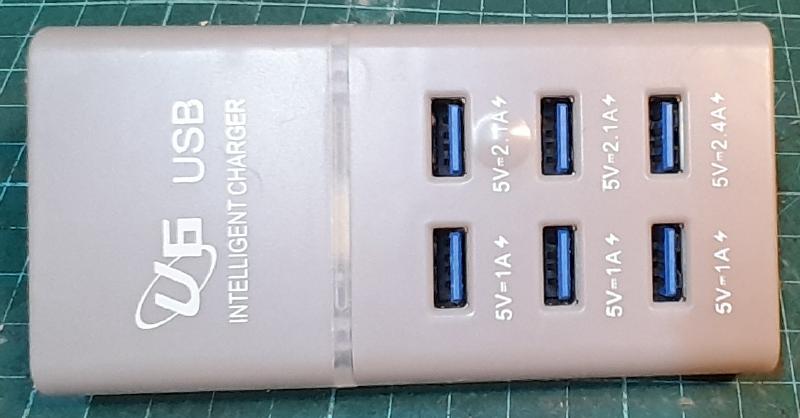
Here we have a USB power hub from the good fellows over at the Value Store. Chinesium AF. It lasted… surprisingly long. Maybe a whole six months in service. Whoop whoop. Note the suspicious-looking bulge under the one “5V 2.1A” port*.
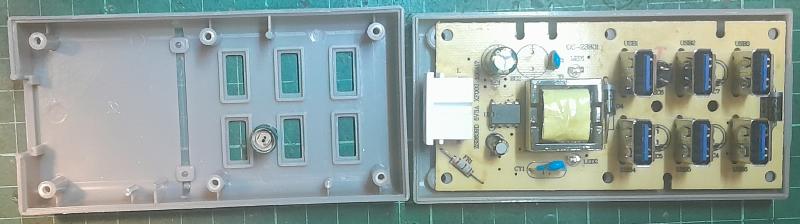
Some force was required to pull it apart, because the bulge is a capacitor that got hot and welded itself to the plastic top.
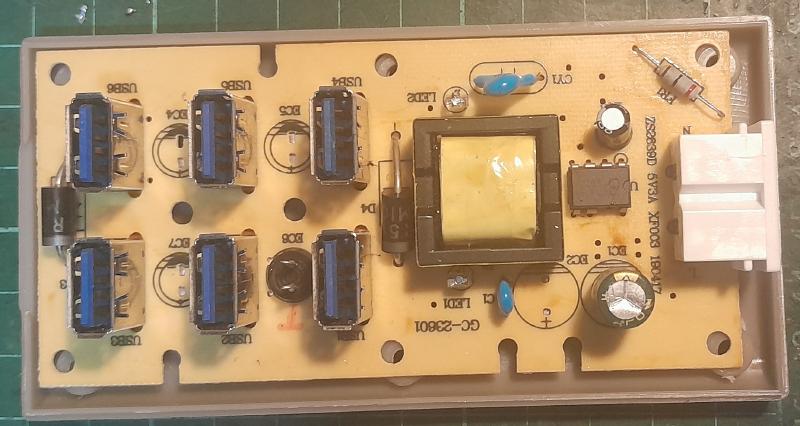
Hmmm. Space for four capacitors, but only one fitted (and “EC2” in the high-voltage department also got diked).
The casualty is marked “1000uF 10V Low ESR 105C”. And it’s 8×12, maybe 8.5×13, which at current capacitor density (assuming they’re not lying about the “Low ESR) is either 470uF at 10V or 1000uF at 6.3V, and that’s pushing it. I suspect the latter, 1000uF at 6.3V (USB is 5V, so that’s OK, right?).
So, the majority of capacitors got Munzed, and then the solo remaining catyarid failed after carrying the load for too long.
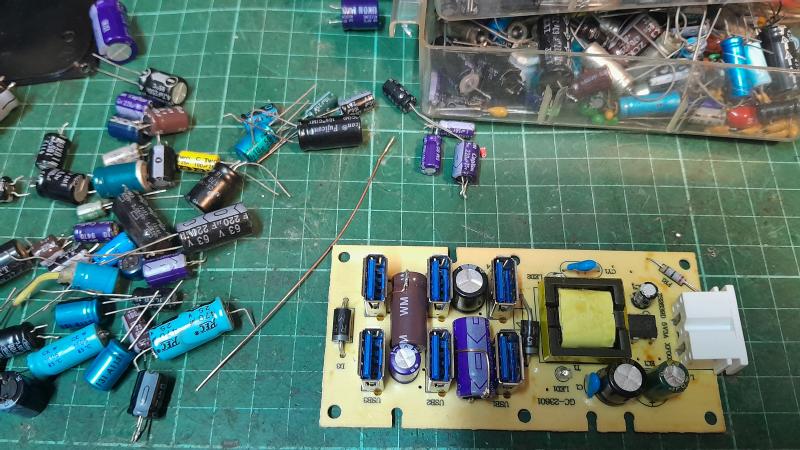
So I fixed it with what I had on hand. Almost 3500uF at mostly 25V (I also added some low-value SMD on the other side). The high-voltage cap I added is only 2.2uF at 400 (the one that was on there is marked “10uF 400V” and it’s the smaller of the two).
* For the record, all six ports are in parallel. All have the same capacity. Which might be 2.1A for all six combined**.
** There is provision for USB-PD resistors, but they are also not fitted.